The window is open, but it will not always stay open. The Body of Christ must speak now about socialism and the public claims of Islam. Silence is not love; it is how a church loses a nation without ever raising its voice.
A pastor stands at a council microphone and is told he is not welcome in his own city. Public money marks one holy month and refuses the others. A democratic socialist, elected mayor of the largest city in the country, freezes the rent on a million homes through boards he appointed. These are not warnings about what might come. They are minutes already entered. And the answer in a great many pulpits is still the same small sentence: be kind, stay out of it, and call the quiet faithfulness.
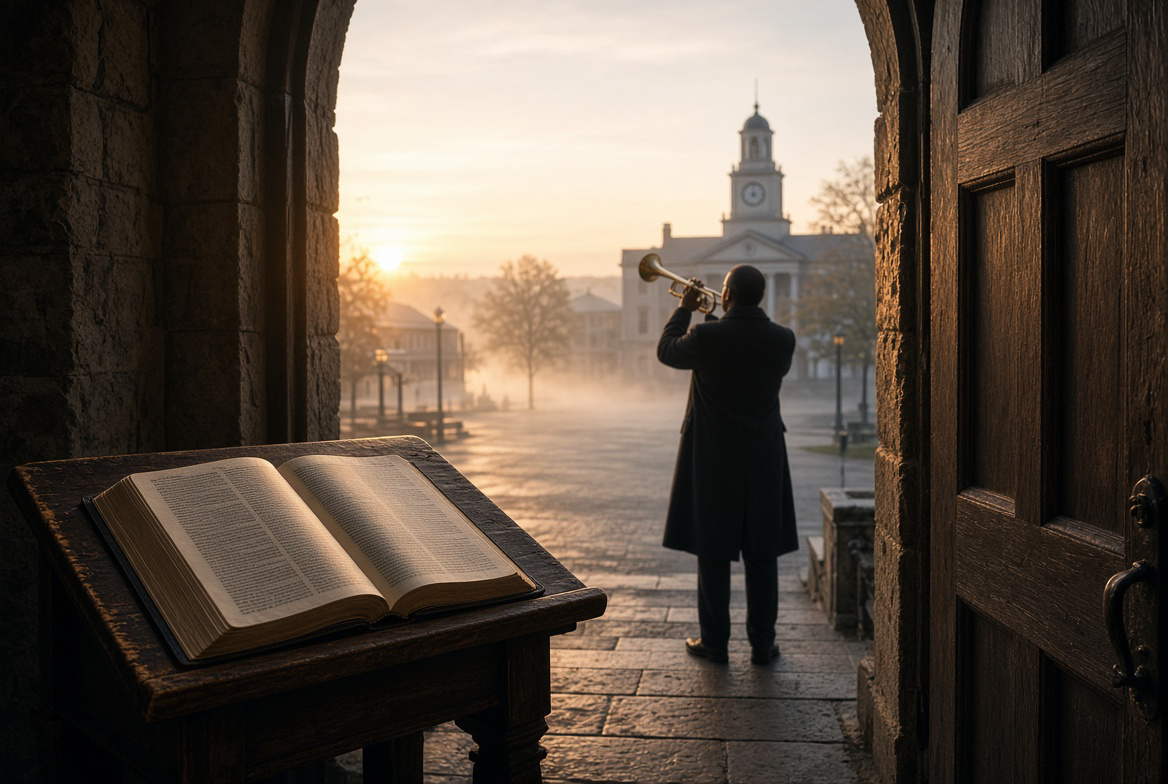
That sentence is a lie. Kindness is commanded. Retreat is not. Love that will not name a danger has already stopped being love. It is sentiment, and sentiment is the watchman keeping his post with the trumpet on the ground. Ezekiel did not threaten the city for seeing the sword. He required the blood from the man who saw it and would not blow. If we don’t speak while speech is still legal, we shouldn’t act surprised when it is no longer polite, then no longer allowed. The next generation will not inherit our good intentions. They will inherit the silence, and the laws the silence made room for.
Two forces are already inside the gate. Socialism is still being sold as compassion with a different tax code. Its record is empty shelves, closed churches, and a peacetime collapse deeper than the Great Depression. Islam in local and federal office is still being treated as a private devotion. Its law punishes leaving the faith and does not mean to stay private. Neither is a theory. Both have a body count and a statute book. The church’s error is not that we have said too much. It is that we have called cowardice kindness, and handed our children the bill.
Socialism Fails The Same Way Every Time It Controls Production
Do not wait for the American version to finish the experiment. It has already been run. Socialism is not a mood. It is a method. The state takes ownership or control of production, replaces prices with political allocation, and then cannot calculate what things are worth or who should make them. The producer does not keep the gain. The planner does not bear the loss. Capital is consumed, and the currency is printed to hide the hole. By the time the shelves are empty, the vote that could have stopped it is already spent.
Venezuela is the cleanest modern case. It holds the world’s largest proven oil reserves and, in the early 2000s, produced more than 3 million barrels a day. After the 2002–2003 oil strike, Hugo Chávez fired roughly 20,000 of the state oil company’s workers. In 2007, he seized the central bank. Across those years, he imposed price controls and nationalized farms and businesses. Output later fell below 500,000 barrels a day in 2020 and was still near 900,000 in 2025. Living standards fell about 74 percent between 2013 and 2023, one of the largest peacetime collapses in modern history, deeper than the American Great Depression. The central bank’s own figure for inflation in 2018 was 130,060 percent. Imports collapsed from about $80 billion to about $10 billion. More than 8 million Venezuelans left the country. Sanctions came late. The firings, the seizure, the price controls, and the money-printing were already underway.
Cuba is the long version of the same experiment. Before 1959 it was among the richer countries in Latin America. After nationalization and central planning, the gap never closed. A synthetic-control study estimated that by 1989 Cuba was about 55 percent poorer than it would have been without the revolution and the embargo, and that the embargo itself explains only a small share of that gap, on the order of 3 to 10 percent. ECLAC’s statistical yearbook for 2025 put Cuban GDP per capita at current prices near $1,083, against a Latin American and Caribbean average near $10,212. On that measure, the island ranked behind Haiti. Current prices overstate the gap, because Cuba’s exchange rate distorts the figure. The same yearbook’s inflation-adjusted measure puts Cuba about 12 percent below the regional average, still last in the region on the current-price rank and still poor. Shortages there are not a temporary shock. They are the steady state of a planned economy.
The Soviet Union is the scale case. Central planning industrialized by force and then stalled. Growth depended on pouring in more labor, capital, and raw materials, not on efficiency. By the 1980s, the system produced chronic shortages, queues, and a black market while official prices were held artificially low. Partial reform loosened orders without creating real prices, and output fell. The 1991 collapse was political, but the economic failure was already visible in empty shelves. The earlier human cost, famine and the gulag, sits on top of that structural failure. Churches were closed. Clergy were imprisoned. Faith was treated as a rival to the state.
The contrast is the reform, not the slogan. China and Vietnam did not get rich by more socialism. They got richer after they allowed private farming, private firms, and market prices. Where the state kept political control and released the economy, output rose. Where it kept both, as in Cuba, North Korea, and Venezuela, scarcity remained. Equality, under socialism, arrives as shared poverty. Loving our neighbor does not require pretending those outcomes are theoretical.
The usual escape clause of the multitude is that this was not real socialism, and that the better model is Sweden or Denmark. Those countries are high-tax market economies with private property, private business, and prices that still clear. They are not worker-owned means of production, and they have spent recent decades rolling back parts of the welfare state when the bills came due. Democratic socialism in American politics is not a Swedish tax rate. It is public control of housing, energy, medicine, and wages, enforced by boards, regulation, and taxation. Venezuela called itself democratic too, until the ballot stopped meaning what it had meant. A Christian does not have to hate the poor to refuse a method that has repeatedly made them poorer and then silenced the church that tried to feed them.
Why Christian’s Cannot Consent To Socialism
The Bible does not name capitalism, and it does not hand us a tax code. It does name theft, coveting, work, household duty, and the difference between a gift and a seizure. Socialism, where it actually governs, collides with those commands. Permitting it is not a neutral political preference. It is consent to a use of the sword that Scripture already forbids when a neighbor does it.
“You shall not steal” (Exodus 20:15). The command is not suspended when the taker is a committee. A state that seizes farms, businesses, and the fruit of labor, and calls the seizure justice, has not escaped the eighth commandment. It has armed it. Samuel warned Israel what a king would do when the people demanded one: he would take their sons, their fields, their vineyards, their flocks, and a tenth of their seed, “and you yourselves will become his servants” (1 Samuel 8:11–17). The warning was not against government. It was against a government whose glory is taking.
The early church is often cited the other way. It should not be. Believers in Jerusalem “had all things in common,” and owners sold land and laid the proceeds at the apostles’ feet (Acts 4:32–35). Peter’s rebuke to Ananias settles the nature of that sharing. “While it remained unsold, did it not remain your own? And after it was sold, was it not under your control?” (Acts 5:4). The field was his. The sale was his. The gift was his. The sin was the lie, not the keeping. Paul later writes that each one must give “not reluctantly or under compulsion, for God loves a cheerful giver” (2 Corinthians 9:7). Compulsion is the opposite of the gift. A government that replaces the giver with a levy has not fulfilled Acts 4. It has abolished the condition that made Acts 4 an act of love.
Scripture also binds work and household provision. “If anyone is not willing to work, then he is not to eat, either” (2 Thessalonians 3:10). “He who steals must no longer steal; but rather he must labor, performing with his own hands what is good, so that he will have something to share with one who has need” (Ephesians 4:28). The order is labor, then share. Sharing is the fruit of work, not a claim on another man’s work. “If anyone does not provide for his own, and especially for those of his household, he has denied the faith and is worse than an unbeliever” (1 Timothy 5:8). A system that punishes the provider, flattens the household, and teaches men to eat from a common pot they did not fill trains people to break that verse and then calls the breakage compassion.
Romans 13 gives the ruler a sword against the one who practices evil. It does not give him the mills, the fields, and the wages. Mercy toward the poor is a Christian duty. It is owed by persons and by the church, in open-handed gift. It is not owed by handing the poor, and everyone else, to a state that owns their labor. To vote for that handover is to ask the magistrate to do what God has forbidden the neighbor to do.
Islam In Office Is No Longer Abstract
The second danger is different in form and the same in consequence, and it is already seated. This is not a future problem. Islam is not merely a private devotion. It carries a public vision of law, speech, family, and the place of other faiths. When that vision gains formal power, “we can all just get along” is not a plan. It is the last thing a people say before the rules change.
The footprint is already measurable. CAIR’s 2026 directory counted a record 255 Muslims in elected office nationwide, including four members of Congress: Ilhan Omar of Minnesota, Rashida Tlaib of Michigan, André Carson of Indiana, and Lateefah Simon of California.
In Congress, the House censured Representative Tlaib in 2023 after she promoted the phrase “from the river to the sea” in the aftermath of the October 7 Hamas massacre. Representative Omar wrote that the United States, Israel, Hamas, and the Taliban had all committed “unthinkable atrocities,” placing a democracy and designated terrorist groups in the same sentence. These are not private opinions discovered in a diary. They are the public record of sitting federal lawmakers.
In Hamtramck, Michigan, the mayor and every member of the city council are Muslim. In 2023, that council voted unanimously to ban Pride flags on city property, with members saying the flag clashed with the religious beliefs of their constituents. A federal judge upheld the ban in 2025. A Christian may share the objection to the flag and still see the mechanism. A religious majority used public authority to settle a civic question by its own law. The same kind of authority has already been turned on Christian speech. Dearborn paid a $300,000 settlement to Christians unlawfully arrested for evangelizing at a city festival.
In Dearborn, Mayor Abdullah Hammoud told Christian pastor Ted Barham that he was “not welcome here” after Barham objected to renaming a street for Osama Siblani, a public supporter of Hamas and Hezbollah. He added that the day Barham moved out would be the day the mayor launched a parade. A lawsuit alleges the city spent public money on Ramadan displays while refusing comparable recognition of Christian and Jewish holidays. At the next council meeting, resident Anthony Deegan asked the mayor and council, by name, whether they denounced Hamas and Hezbollah or supported them. No council member answered. When the mayor spoke, he did not denounce either group. He talked about coexistence. Dearborn is the first large Arab-majority city in the United States. The question is not whether Muslims may live there. The question is whether a mayor may tell a Christian resident he is unwelcome for objecting to a civic honor, and then refuse to say that Hamas and Hezbollah are evil.
That silence is not a local accident. In February 2024, the House voted 418–0 to condemn Hamas’s use of rape and sexual violence as a weapon of war. Rep. Rashida Tlaib was the only member voting who would not vote yes. She voted present. She said the resolution ignored claims about Israeli forces. She would not join a unanimous chamber in saying that what Hamas did was evil. Three months earlier, Rep. Ilhan Omar voted no on the resolution standing with Israel and condemning Hamas’s October 7 attack. It passed 412–10. She said it failed to mourn Palestinian deaths. In Michigan, state Rep. Abraham Aiyash of Hamtramck blocked a House resolution condemning the same attack because it did not also indict Israel. His explanation was that you cannot talk about October 7 without talking about the conditions in Gaza. In New York, Mayor Zohran Mamdani has refused to denounce the phrase “globalize the intifada.”
Hamas, Hezbollah, and Al-Qaeda are designated terrorist organizations. They have murdered Americans and Jews, and they have said they intend to keep doing it. Omar’s own phrase for September 11 was that “some people did something.” An officeholder who will not say the plain sentence, when asked in a council chamber or on a House floor, is not waiting for more evidence. He is refusing it. Not every Muslim in office has been asked, and not every one refuses. Abdul El-Sayed, a Muslim candidate in Michigan, has condemned Hamas. The ones who were asked in these rooms would not say it.
In New York, Zohran Mamdani, a Muslim democratic socialist, became mayor in 2026. His platform joined the two subjects of this article in one office: an Islamic religious identity and an explicitly socialist economic program, including a rent freeze on roughly a million apartments carried out through boards he appointed. Representation and ideology are not the same thing. Here they arrived together.
Islamic Law Already Shows What It Does With Power
The danger is not that a city council will order a stoning next year. It is that a legal tradition which punishes leaving the faith, weights testimony by sex, and treats criticism of Islam as a crime is gaining officeholders, while the church is told that naming that tradition is unloving.
Where Islamic law functions as public law, the record is not obscure. About a dozen countries still allow the death penalty for apostasy, the act of leaving Islam. Lists commonly include Afghanistan, Iran, Saudi Arabia, Qatar, the United Arab Emirates, Yemen, Mauritania, and Brunei. Several of those, along with Pakistan and parts of northern Nigeria, also prescribe death for blasphemy. Enforcement ranges from execution to prison, loss of inheritance, or loss of citizenship. The rule’s point does not change with the penalty: Islam is not a faith you may freely leave.
Classical hudud punishments remain on the books where Sharia is criminal law. Theft can mean amputation of the hand. Married adultery can mean stoning. Alcohol can mean flogging. Highway robbery can mean crucifixion or cross-amputation. Saudi Arabia, Iran, and Taliban Afghanistan still use versions of this system. Northern Nigerian states and Indonesia’s Aceh province apply pieces of it. Strong evidence rules make stoning rare. Flogging, imprisonment, and amputation are not theoretical.
Family law is the part most often exported. Under classical rules, a daughter inherits half a son’s share. A husband’s testimony can outweigh a wife’s. A man may divorce by pronouncement. A woman often needs a council or a court. Polygamy is lawful for men. Male guardianship still limits travel, marriage, or work in several Gulf and South Asian systems. Iran’s hijab enforcement has moved from fines to travel bans and prison. These are current statutes, not medieval footnotes.
The West already has a preview that does not require criminal courts. Britain has no Sharia criminal code, but dozens of Sharia councils, commonly estimated at around 85, issue religious rulings on marriage and divorce. An estimated 100,000 Islamic marriages in Britain were never civilly registered, so women in those marriages often have no ordinary civil divorce and must seek a religious one from an almost entirely male panel. A 2018 Home Office review found the councils unregulated and in tension with English family law. Parliament never imposed the registration fix the review recommended. The effect is a second track for Muslim family disputes, weaker for wives and children.
In the United States, the same pattern is still cultural and political rather than criminal. Hamtramck and Dearborn are early uses of office, not amputations. Polling tracks the direction. A late-September 2026 national survey found that 43 percent of likely voters ages 18 to 24 held a positive view of Sharia, against 21 percent of voters overall. About a quarter of voters under 35 said they would support Sharia as the legal code of an American town, city, or state. Full Sharia and “representation” are different stages of the same public claim.
What Scripture Requires Of Us
The Bible does not give Christians a ballot diagram. It does tell us what kind of people may rule, what love does with evil, and how the church is to speak. In a republic, the vote is one of the ordinary means God has given us to answer those commands. Silence at the ballot box is not neutrality. It is a choice to leave the gate unattended.
On the character of rule, Proverbs is direct. “When the righteous increase, the people rejoice, but when a wicked person rules, people groan” (Proverbs 29:2). “The king gives stability to the land by justice, but a person who takes bribes overthrows it” (Proverbs 29:4). “Righteousness exalts a nation, but sin is a disgrace to any people” (Proverbs 14:34). A Christian vote is not a hunt for a savior. It is a judgment about which laws, rulers, and policies move a people toward righteousness or toward disgrace. We are responsible for the judgment we can actually cast.
On love, Paul refuses the modern separation of warmth from opposition. “Love must be free of hypocrisy. Detest what is evil; cling to what is good” (Romans 12:9). The same chapter ends where many churches stop: “Do not be overcome by evil, but overcome evil with good” (Romans 12:21). Overcoming evil is not the same as ignoring it. Amos puts the public form of that command in one line: “Hate evil, love good, and establish justice in the gate!” (Amos 5:15). The gate was the court and the council. Justice there was not a private feeling. It was a civic act. To love the neighbor who will live under a bad law is to oppose the law.
On speech, the charge is to open the mouth, not to manage a brand. “Open your mouth for the people who cannot speak, for the rights of all the unfortunate. Open your mouth, judge righteously, and defend the rights of the afflicted and needy” (Proverbs 31:8–9). Paul tells the church, “Do not participate in the useless deeds of darkness, but instead even expose them” (Ephesians 5:11). Exposing is public. It names the deed. The early church, under threat, did not ask for a softer message. They prayed, “And now, Lord, look at their threats, and grant that Your bond-servants may speak Your word with all confidence” (Acts 4:29). Paul later writes, “For God has not given us a spirit of timidity, but of power and love and discipline” (2 Timothy 1:7). Power, love, and discipline belong in the same sentence. Boldness without love becomes cruelty. Love without boldness becomes permission.
None of this cancels the command to seek the good of the city, or to be subject to governing authority where obedience to God does not forbid it. “Seek the prosperity of the city where I have sent you,” the Lord told the exiles, “and pray to the Lord in its behalf; for in its prosperity will be your prosperity” (Jeremiah 29:7). Paul adds that the ruler is “a servant of God to you for good” and “an avenger who brings wrath on the one who practices evil” (Romans 13:4). We do not get to skip the city. We also do not get to call a wicked use of the sword good because saying otherwise feels political.
The harder text is the watchman. “If the watchman sees the sword coming and does not blow the trumpet and the people are not warned, and a sword comes and takes a person from them, he is taken away for his guilt; but I will require his blood from the watchman’s hand” (Ezekiel 33:6). The church is not the magistrate. It is responsible for the warning. Salt that loses its taste is thrown out. A lamp is not lit to be put under a basket (Matthew 5:13–15). We vote, we oppose evil, and we speak, because righteousness exalts a nation and because love detests what destroys the people we claim to love.
What To Do With This
A warning that ends in a mood is not yet obedience. The work is local before it is national, and it is ordinary before it is dramatic. A church that will not learn the names on its own ballot has not yet begun to keep Proverbs 29.
Start with the gate in front of you. Read the city council agenda, the school board packet, and the sample ballot before the meeting, not after the vote. Know who is asking for a street name, a curriculum change, a public religious display, a housing board, or a tax that moves ownership from the household to the city. Then go. Two minutes at a microphone, given calmly and with the text in hand, does more than a month of private alarm. Vote as if Proverbs 29 were written for a republic, because the principle was. A Christian vote is not a search for a savior. It is a judgment about which laws move a people toward righteousness or toward disgrace.
Teach before you post. Children should hear, in the church and at the table, the difference between a neighbor and a doctrine. The neighbor is to be loved, fed, and protected. The doctrine may be rejected. Socialism is not compassion, and Islam is not a private hobby that happens to have a law book. Pastors should say this from the pulpit on purpose, not only when a controversy forces it. A congregation that never hears Ezekiel 33, Acts 5:4, or Romans 12:9 will treat the first hard sermon as a breach of etiquette. Catechize the adults too. Most silence in the pew is not cowardice at the start. It is the lack of a sentence. Give people the sentence.
Keep the work attached to mercy. Opposing a bad law while ignoring the poor next door trains the city to hear the church as a faction. Provide for households. Support the widow. Help the immigrant who is not asking for a second law. Speak to Muslim neighbors as people for whom Christ died, and do not pretend their public doctrine is harmless in order to keep the conversation. Courtesy and clarity belong in the same visit. A church that will not evangelize has no business only warning.
Pay the cost with other people, not alone. Elders should decide in advance what the church will say if a street, a festival, or a school policy puts Christian speech on the wrong side of a new rule. Members should know the church will stand with the member who speaks. Give to congregations already paying a higher price than a comment thread, including churches under governments that have already closed the window. And refuse the bargain that calls silence love. The trumpet is a church act. It is not a personality.
This is not a word against Muslim neighbors, or against the poor. It is a word against two public claims: that the state should own the economy, and that Islamic law should gain the standing of a civic authority. People are not the claim. The claim can still be answered, and it will be answered by the churches that show up before the custom hardens into a rule.
Love Is Not A Substitute For Truth
Christians are commanded to love their neighbors, including socialists and Muslims. That love does not require us to bless a system that consumes capital and closes churches, or a legal vision that punishes apostasy and ranks other faiths beneath itself. Civic friendship is not the same thing as shared first principles. The harder claim is that love which will not tell the truth has already stopped being love.
Scripture does not set the two against each other. The Word became flesh and dwelt among us, “full of grace and truth” (John 1:14). Not grace instead of truth, and not truth with the grace trimmed off for courage. Paul tells the church to grow up by “speaking the truth in love” (Ephesians 4:15). The phrase is one motion. Truth spoken without love can be a weapon. Love that will not speak the truth is a different sin, and it is the sin this hour rewards. It feels like mercy. It functions as abandonment.
Love, in Paul’s account, “does not rejoice in unrighteousness, but rejoices with the truth” (1 Corinthians 13:6). A church can be endlessly kind and still rejoice in unrighteousness, if kindness has become the refusal to name it. The kisses of an enemy are deceitful. “Faithful are the wounds of a friend” (Proverbs 27:6). The wound is not the failure of love. The flattery is. To tell a neighbor that the law about to govern his children is harmless, because saying otherwise might offend him, is not friendship. It is a kiss.
The same duty is public. “These are the things which you shall do: speak the truth to one another; judge with truth and judgment for peace at your gates” (Zechariah 8:16). Peace at the gates is not purchased by silence at the gates. A false peace leaves the controversy in the street and calls the quiet unity. Real peace requires a true judgment. That is why the watchman is guilty if he sees the sword and does not blow the trumpet. He did not swing it. He hid the warning, and God required the blood from his hand.
Jesus did not treat hard speech as a lapse in love. He wept over Jerusalem and told it the truth that would get Him killed. He ate with sinners and did not leave them in the sin that was killing them. He said the truth would make people free (John 8:32), which assumes the truth is spoken where it can be heard. Paul told the Ephesian elders, “I did not shrink from declaring to you the whole purpose of God” (Acts 20:27). Shrinking is the temptation. The whole purpose includes the parts that cost the speaker his welcome. “If I were still trying to please people, I would not be a bond-servant of Christ” (Galatians 1:10).
There is a time limit on the permission. “For the time will come when they will not tolerate sound doctrine; but wanting to have their ears tickled, they will accumulate for themselves teachers in accordance with their own desires, and they will turn their ears away from the truth” (2 Timothy 4:3–4). The charge attached to that warning is not to wait for a safer room. It is to preach the word, “in season and out of season,” to “reprove, rebuke, exhort, with great patience and instruction” (2 Timothy 4:2). Patience is in the verse. So are reproof and rebuke. A church that keeps the patience and drops the rebuke has not obeyed the sentence. It has edited it.
So the love we owe the neighbor is not a softer public square. It is the truth told in time for him to act on it: that a state which seizes the fruit of labor will soon seize the church that objects, and that a law which forbids leaving Islam will not stay politely inside the mosque. We owe him our courtesy, our help, and our refusal to lie. We owe our children the same refusal. Boldness is not cruelty. It is the refusal to hand the next generation a public square we were too polite to defend.
Speak now. Not after the next election. Not when the room feels safer. Love people. Tell the truth. The window for that speech is already narrowing, and it closes the way it has closed before: first by custom, then by policy, then by penalty. A pastor is told he is not welcome at the council microphone. A Christian who names apostasy law is marked as the threat to peace. A church that will not bless the new settlement loses its place, and then wonders when the square became someone else’s. None of that requires a stoning. It requires only that the people who still have a voice decide the voice is impolite. That decision is being made now, in pulpits that skip the text and in pews that call the skip wisdom. If we do not speak loudly while speech is still permitted, we will live to see the day it is not. Our children will not inherit our intentions. They will inherit the silence we kept, and the laws that silence made room for. Blow the trumpet. The sword is already in sight.
References
Venezuela
- Yale Climate Connections, “Five keys to understanding Venezuela’s oil history” (2026) — oil reserves, pre-Chávez production above 3 million barrels per day, 2002–2003 PDVSA firings, later output decline.
- BrentChart, “Venezuela Oil: PDVSA, the Orinoco Belt, Sanctions, and the Chevron License” — PDVSA technical dismissals after the 2002–2003 strike and production collapse.
- Cato Institute, “How Socialism Destroyed Venezuela in 16 Charts” (2026) — central-bank seizure (2007), inflation near 130,000 percent (2018), emigration exceeding 8 million.
- Economics Observatory, “Why did Venezuela’s economy collapse?” (2024) — living standards fell ~74 percent (2013–2023); imports from over $80 billion to around $10 billion; emigration above 7.7 million.
- Asia Times, “Anatomy of an economic suicide: Venezuela under Maduro” (2026) — BCV official inflation figure of 130,060 percent (2018); oil production near 0.9 million barrels per day (2025).
Cuba
- The Daily Economy / AIER, “Socialism, Not the Embargo, Explains Nearly All of Cuba’s Poverty” (2025) — summary of synthetic-control findings (Cuba ~55 percent poorer by 1989; embargo 3–10 percent of the gap).
- Bastos, Geloso, and Pavlik, “The Forsaken Road” (Journal of Development Economics, forthcoming) — full synthetic-control study.
- ECLAC, Statistical Yearbook for Latin America and the Caribbean 2025 — Cuban GDP per capita at current prices ~$1,083 vs. regional average ~$10,212; constant-price measure ~12 percent below regional average. Reported in Diario de Cuba and CiberCuba.
Islam in American office
- CAIR / CAIR Action, “RECORD-BREAKING: CAIR, CAIR Action Identify 255 Muslim Elected Officials in New 2026 Directory” (August 2026) — 255 elected Muslim officials, including four members of Congress.
- New York Post, “Dearborn’s Muslim mayor tells Christian he’s ‘not welcome’…” (September 2025) — Mayor Hammoud’s statements to Pastor Ted Barham.
- Middle East Forum, “The New Jim Crow in Dearborn” — September 23, 2025 council meeting; Deegan’s question on Hamas and Hezbollah; no denunciation.
- Michigan Advance, “Federal appeals court upholds Hamtramck’s ban on Pride flags on city property” (August 2026) — all-Muslim council, 2023 ban, 2025 district-court dismissal, 2026 Sixth Circuit affirmation.
- Haaretz, “U.S. House of Representatives Votes to Condemn Hamas’ Sexual Violence… Rashida Tlaib Abstains” (February 2024) — 418–0 vote; Tlaib voted “present.”
- Newsweek, “Rashida Tlaib Blasted Over Hamas Rape Vote” (February 2024) — same vote and Tlaib’s statement.
- Business Insider, “These 16 Lawmakers Didn’t Vote for Israel Resolution After Hamas Attacks” (October 2023) — H. Res. 771 passed 412–10; Omar voted no.
- Patch, “Ilhan Omar Votes ‘No’ On Resolution Condemning Hamas Terrorist Attacks” (October 2023) — Omar’s statement on the resolution.
- Voz.us, “Michigan Democrats refuse to officially condemn Hamas…” (October 2023) — Aiyash and the blocked Michigan resolution.
- Muslim Network TV, “42 Muslim Americans win in US elections…” (November 2025) — Mamdani elected New York City mayor.
Islamic law and polling
- Home Office independent review of Sharia councils (2018) — estimated range of 30–85 councils; findings on unregistered marriages.
- Full Fact, “Misleading ‘fact’ sheet about UK Muslims recirculates” (2026) — confirms Home Office range of 30–85 councils and lack of official count.
- Rasmussen Reports, “Sharia Law: 43% of Youngest Voters Like It” (September 20, 2026 survey) — 43 percent of ages 18–24 positive on Sharia (21 percent overall); roughly one-quarter under 35 would support it as local legal code.
- Decision magazine, “Young US Voters Have Surprisingly Favorable View of Sharia Law: Poll” — same Rasmussen / Our Republic poll.
Notes
CAIR’s 255 figure is an advocacy directory, not an official census. British council and marriage figures are estimates. Cuba’s current-price GDP is distorted by the exchange rate. Venezuela’s 130,060 percent inflation figure is the central bank’s own 2018 number. The Dearborn $300,000 settlement is reported in secondary coverage of the evangelism arrests.